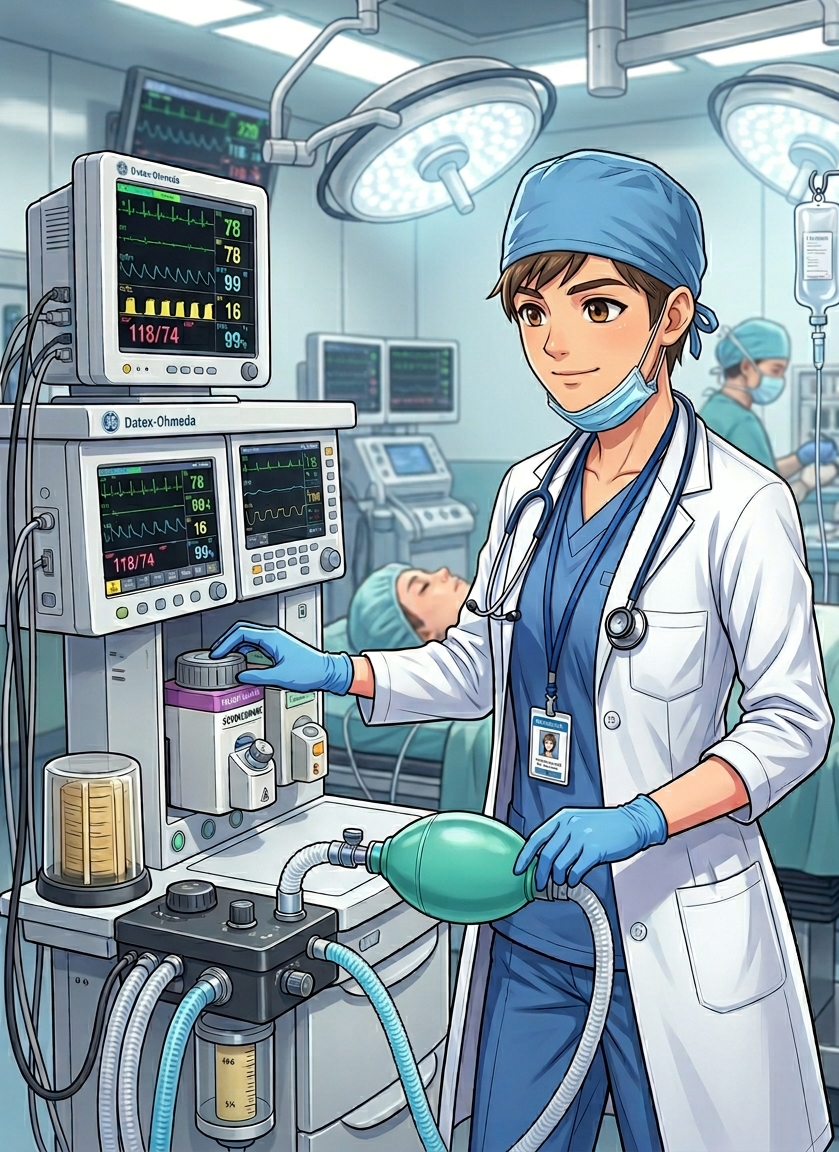
Dedicated medical professional currently pursuing a residency in Anesthesiology & Critical Care based in Nepal. My clinical focus centers on perioperative safety, precision airway management, and evidence-based pain therapy.
Committed to delivering safe, high-quality patient care while advancing anesthesia science through continuous learning, research participation, and translating global standards into the Nepali healthcare context.
My interests span from ultrasound-guided regional techniques and neuraxial blocks to ICU management of the critically ill — always driven by data, empathy, and vigilance.
Focused clinical training across core domains of modern anesthesiology and critical care medicine.
Advanced laryngoscopy, video-assisted intubation, difficult airway protocols, and supraglottic device expertise in elective and emergent settings.
CORE COMPETENCYUltrasound-guided peripheral nerve blocks, neuraxial techniques, and multimodal analgesia strategies for enhanced recovery (ERAS) protocols.
NERVE BLOCKS · NEURAXIALICU management of mechanically ventilated patients, hemodynamic optimization, sepsis bundles, ARDS protocols, and multiorgan support therapy.
ICU · ARDS · SEPSISAcute post-operative pain control, chronic pain intervention, and opioid-sparing multimodal analgesic regimens tailored per patient profile.
ACUTE · CHRONIC · PERI-OPBrain protection strategies, ICP monitoring, BIS-guided depth of anesthesia, and intraoperative neurophysiological monitoring for neurosurgery.
NEURO-MONITORING · BISLabour epidurals, cesarean section analgesia, high-risk obstetric cases, and maternal hemodynamic management throughout the peripartum period.
LABOUR · C-SECTION · OBThe waveforms that guide every decision in the operating room and intensive care unit — live-rendered below.
Electrical depolarization of the myocardium. P wave: atrial, QRS: ventricular, T wave: repolarization. HR: 60–100 bpm normal.
Photoplethysmographic waveform detecting pulsatile blood volume changes. Dicrotic notch marks aortic valve closure.
Carbon dioxide waveform with four phases. Phase III plateau reflects alveolar CO₂. EtCO₂ 35–45 mmHg = normocarbia.
Invasive arterial pressure tracing. Rapid upstroke = systole. Dicrotic notch = aortic valve closure. Enables beat-to-beat hemodynamics.
Airway pressure during mechanical ventilation. Peak = inspiratory, plateau = static compliance, PEEP = expiratory baseline.
Bispectral Index from processed EEG. 40–60: general anesthesia, 60–80: sedation, 80–100: awake. Prevents awareness.
Real-time simulated anesthesia monitoring — the HUD that guides every OR decision.
Where science, precision, and compassion converge. Click any image to expand.


🖐 Move → Rotate
🤏 Pinch → Expand
✌️ Peace → Next shape
Shape: sphere